

Balloon Enteroscopy - Small Bowel Examination & Treatment
- Advanced Endoscopy
- Upper GI Endoscopy
- Lower GI Endoscopy (Colonoscopy)
- ERCP (CBD Stone Removal / Stenting)
- EUS Guided Procedures (FNA/FNB, Drainage)
- Single / Double Balloon Enteroscopy
- Esophageal / Antral Stenting
- Esophageal & Anorectal Manometry
- Foreign Body Removal
- PEG Tube Placement
- POEM (Peroral Endoscopic Myotomy)
- STER (Submucosal Tunneling Endoscopic Resection)
- ESD (Endoscopic Submucosal Dissection)
- EMR (Endoscopic Mucosal Resection)
- Spyglass for Pancreatic Biliary Pathology
- Gastrointestinal Bleeding
- Biliary & Pancreatic Stenting
- Anti Reflux Procedures
Balloon Enteroscopy: In-depth Small Bowel Examination
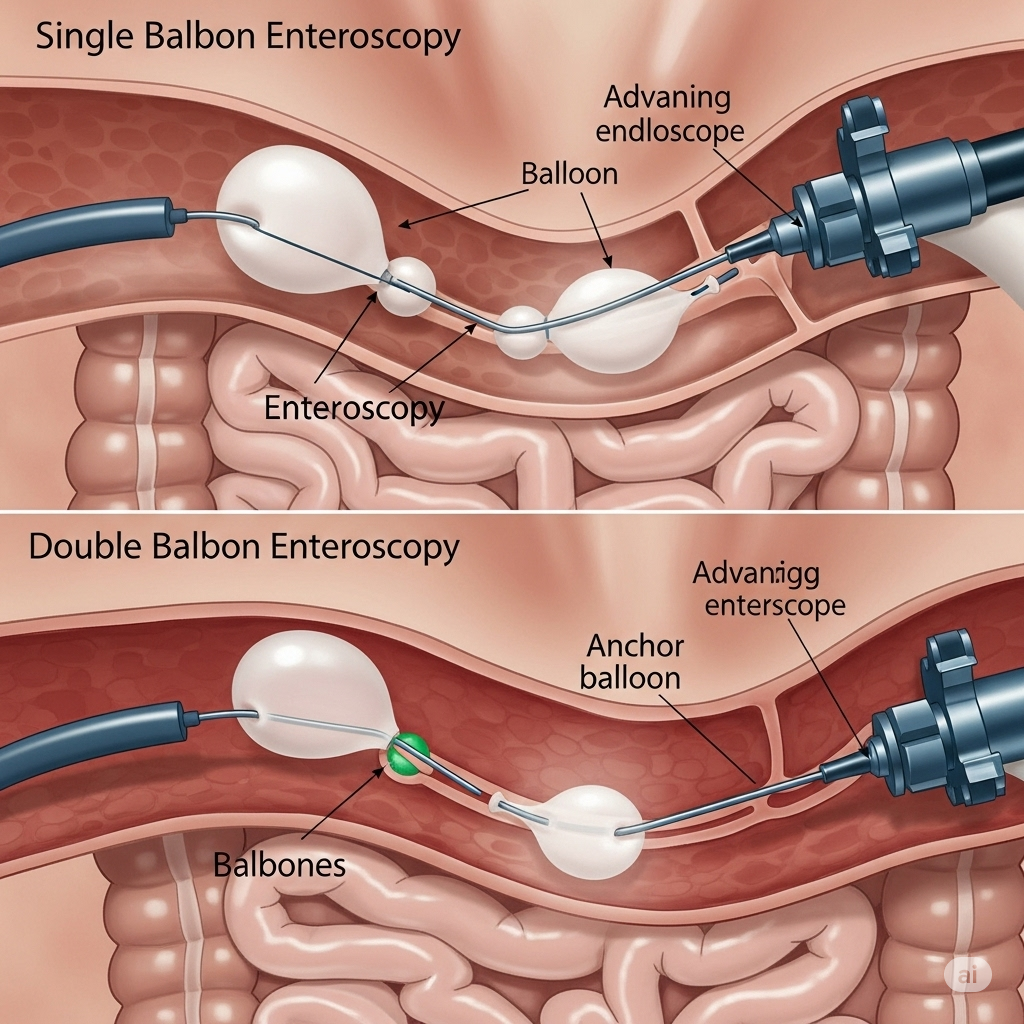
Balloon Enteroscopy: Reaching Where Other Scopes Cannot
The small intestine is a long, winding organ (about 20 feet) that traditional endoscopes (Upper GI Endoscopy and Colonoscopy) cannot fully visualize. When a suspected problem lies beyond the reach of these standard scopes, **Balloon Enteroscopy (Single or Double Balloon Enteroscopy)** performed by Dr. Neeraj Dhar offers an advanced solution to thoroughly examine and treat conditions of the entire small bowel.
What is Balloon Enteroscopy?
Balloon Enteroscopy is a specialized endoscopic procedure that uses an endoscope with one or two inflatable balloons (on the scope itself and/or on an overtube). These balloons are alternately inflated and deflated to "pleat" or "accordion" the small intestine onto the endoscope, allowing Dr. Dhar to advance the scope deep into, and sometimes through, the entire length of the small bowel. This technique enables direct visualization of the small intestinal lining, tissue sampling (biopsies), and therapeutic interventions.
Types of Balloon Enteroscopy:
- Single Balloon Enteroscopy (SBE): Uses one balloon at the tip of the endoscope.
- Double Balloon Enteroscopy (DBE): Uses two balloons, one on the endoscope and one on an overtube, allowing for more efficient and deeper advancement.
Why is Balloon Enteroscopy Performed? (Indications)
This procedure is typically recommended when a problem in the small intestine is suspected but cannot be reached by conventional endoscopy or colonoscopy. Common indications include:
- Obscure Gastrointestinal Bleeding (OGIB): This is the most common reason, when the source of bleeding (anemia, black stools, blood in stools) is not found in the upper or lower GI tract. Balloon enteroscopy helps identify and treat bleeding lesions like angioectasias, ulcers, or tumors.
- Evaluation of Small Bowel Lesions: Detecting and characterizing polyps, tumors, strictures, or inflammation.
- Suspected Crohn's Disease: Diagnosing and assessing the extent of Crohn's disease in the small intestine.
- Removal of Foreign Bodies: Extracting swallowed objects lodged in the small bowel.
- Biopsy for Malabsorption: Obtaining tissue samples to investigate conditions causing nutrient malabsorption.
- Surveillance: For patients with certain genetic syndromes (e.g., Peutz-Jeghers syndrome) that predispose to small bowel polyps.
- Stent Placement: Placing stents for small bowel strictures.
Preparation for the Procedure:
Preparation varies depending on whether the procedure is performed via the oral or anal route:
- Fasting: You will need to fast for 8-12 hours prior to the procedure.
- Bowel Preparation: If the procedure is performed anally (through the rectum and colon), you will need to undergo a thorough bowel preparation similar to a colonoscopy to ensure a clear view.
- Medication Review: Discuss all your medications with Dr. Dhar, especially blood thinners, as they may need to be temporarily stopped.
- Arranging for a Ride: Due to sedation, you must arrange for someone to drive you home.
What to Expect During the Procedure:
- The procedure is performed under deep sedation or general anesthesia for your comfort.
- The enteroscope is inserted either through the mouth (for upper small bowel access) or through the anus and colon (for lower small bowel access).
- Using the balloon mechanism, Dr. Dhar will carefully advance the scope deep into your small intestine.
- The camera allows for direct visualization of the lining. If abnormalities are found, biopsies can be taken, or therapeutic interventions (like cautery for bleeding, polyp removal) can be performed.
- The duration of the procedure can vary significantly, from 1 to 3 hours or more, depending on the extent of examination and interventions needed.
Recovery and Post-Procedure Care:
- You will be monitored in a recovery area until the effects of sedation wear off.
- Mild abdominal discomfort, bloating, or a sore throat are common but usually subside quickly.
- You will receive instructions on when to resume eating and normal activities.
- Close monitoring for potential complications like bleeding or perforation will be done.
Why Choose Dr. Neeraj Dhar for Balloon Enteroscopy?
Dr. Neeraj Dhar is an expert in advanced endoscopic procedures, including both Single and Double Balloon Enteroscopy, in Faridabad. His specialized skills and experience in navigating the complex anatomy of the small intestine are critical for successful outcomes in these challenging procedures. Dr. Dhar utilizes the latest technology to ensure accurate diagnosis and effective treatment of obscure small bowel conditions. His commitment to patient-centric care, combined with his proficiency in advanced endoscopy, makes him a trusted choice for patients requiring in-depth small bowel examination.
If you have symptoms suggesting a small bowel disorder or have had inconclusive findings from other GI investigations, schedule a consultation with Dr. Neeraj Dhar to discuss if Balloon Enteroscopy is the right diagnostic or therapeutic option for you.