

EMR (Endoscopic Mucosal Resection)
- Advanced Endoscopy
- Upper GI Endoscopy
- Lower GI Endoscopy (Colonoscopy)
- ERCP (CBD Stone Removal / Stenting)
- EUS Guided Procedures (FNA/FNB, Drainage)
- Single / Double Balloon Enteroscopy
- Esophageal / Antral Stenting
- Esophageal & Anorectal Manometry
- Foreign Body Removal
- PEG Tube Placement
- POEM (Peroral Endoscopic Myotomy)
- STER (Submucosal Tunneling Endoscopic Resection)
- ESD (Endoscopic Submucosal Dissection)
- EMR (Endoscopic Mucosal Resection)
- Spyglass for Pancreatic Biliary Pathology
- Gastrointestinal Bleeding
- Biliary & Pancreatic Stenting
- Anti Reflux Procedures
Endoscopic Mucosal Resection (EMR)
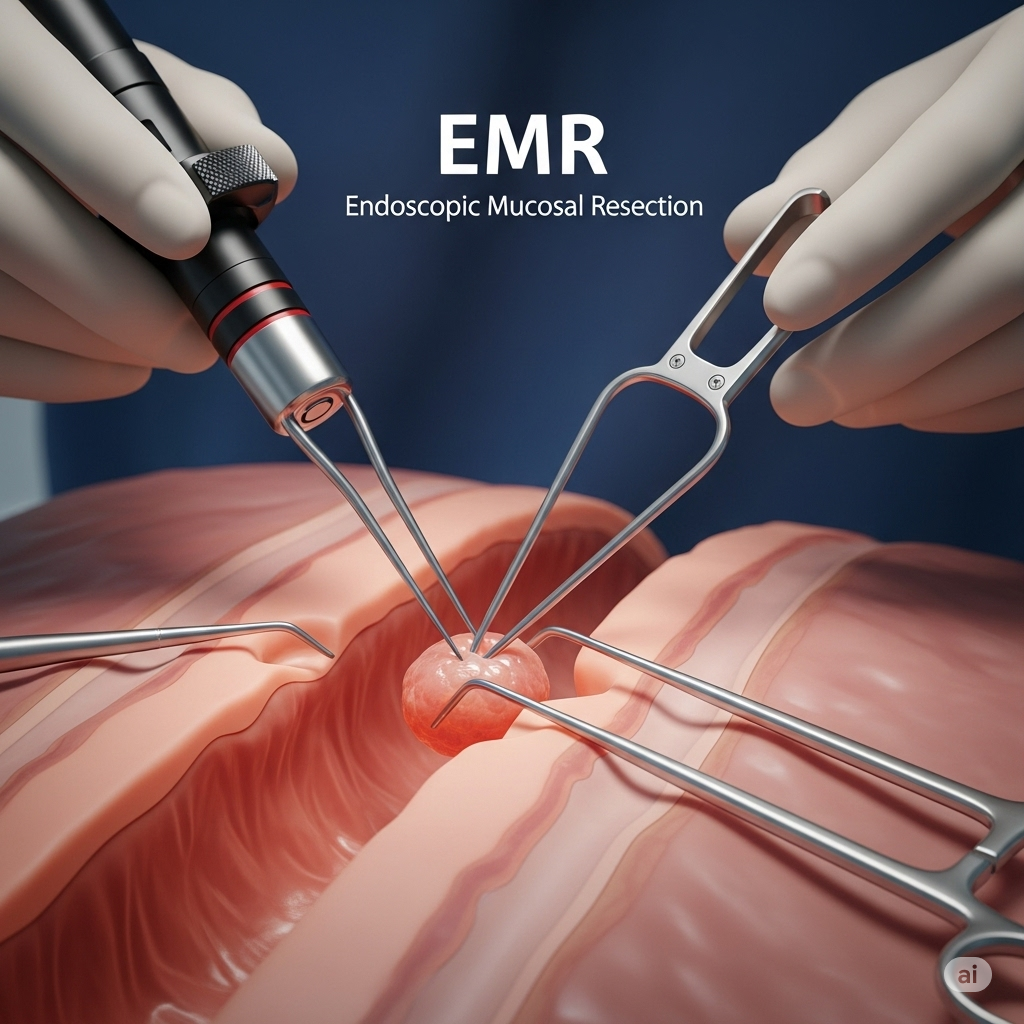
EMR: Minimally Invasive Removal of Early GI Lesions
**Endoscopic Mucosal Resection (EMR)** is a sophisticated and minimally invasive endoscopic procedure used to remove precancerous lesions (dysplasia) and early-stage superficial cancers that are confined to the inner lining (mucosa) or the superficial submucosal layer of the gastrointestinal tract. EMR offers a less invasive alternative to surgery for selected lesions, preserving organ function and leading to faster recovery.
What is Endoscopic Mucosal Resection (EMR)?
During an EMR procedure, Dr. Neeraj Dhar uses a flexible endoscope to identify and remove abnormal tissue. The key step in EMR involves injecting a solution (usually saline) into the layer beneath the lesion (submucosa). This creates a fluid cushion that lifts the lesion, separating it from the deeper muscle layers. This lifting technique makes it safer to remove the lesion with an endoscopic snare, effectively "resecting" it from the mucosal layer. The resected tissue is then retrieved and sent for pathological analysis to confirm the diagnosis and ensure complete removal.
Why is EMR Performed? (Indications)
EMR is a highly effective treatment option for various superficial lesions across the GI tract:
- **Large or Flat Polyps:** Especially those in the colon that are too large or complex for standard polypectomy.
- **Barrett's Esophagus with High-Grade Dysplasia or Early Esophageal Cancer:** When the abnormal cells are confined to the mucosal layer.
- **Early Gastric or Duodenal Cancer:** If the cancer is superficial and has not invaded deeply into the stomach or duodenal wall.
- **Adenomas in the Stomach or Small Intestine:** Premalignant growths that have a high risk of transforming into cancer.
- **Sessile Serrated Lesions (SSLs):** A type of precancerous colon polyp that can be difficult to remove completely with conventional methods.
The goal of EMR is to remove these lesions completely, preventing them from progressing to advanced cancer or, in the case of early cancers, providing a curative treatment without the need for major surgery.
Benefits of EMR:
- **Minimally Invasive:** Avoids open surgery, leading to shorter hospital stays, less pain, and faster recovery.
- **Organ Preservation:** The esophagus, stomach, or colon is preserved, maintaining normal digestive function.
- **Diagnostic and Therapeutic:** Allows for complete removal of the lesion for definitive pathological analysis, while simultaneously treating the condition.
- **High Success Rate:** For carefully selected cases, EMR offers an excellent chance of complete lesion removal.
Preparation for the Procedure:
Preparation varies depending on the location of the lesion:
- Upper GI EMR (Esophagus, Stomach, Duodenum): You will need to fast for at least 6-8 hours before the procedure (no food or drink) to ensure your upper GI tract is empty.
- Lower GI EMR (Colon, Rectum): Comprehensive bowel preparation will be required, similar to a colonoscopy, to ensure the bowel is thoroughly cleaned for clear visualization.
- Medication Review: Inform Dr. Dhar about all your medications, especially blood thinners, as these may need to be stopped or adjusted to minimize bleeding risk.
- Arranging for a Ride: Since you will receive sedation, you must arrange for someone to drive you home after the procedure and stay with you for a few hours.
What to Expect During the Procedure:
- EMR is performed under **conscious sedation** or sometimes **general anesthesia**, ensuring your comfort throughout the procedure.
- Dr. Dhar will insert a flexible endoscope through your mouth (for upper GI EMR) or rectum (for lower GI EMR) to reach the lesion.
- The area around the lesion will be injected with a lifting solution.
- Using specialized endoscopic instruments, the lesion is then precisely cut and removed. For larger lesions, EMR may be performed in multiple pieces (piecemeal EMR).
- Any bleeding is immediately controlled using endoscopic clips or electrocautery.
- The resected tissue is retrieved for pathological examination.
- The procedure duration varies depending on the size, location, and complexity of the lesion, typically ranging from 30 minutes to over an hour.
Recovery and Post-Procedure Care:
- You will be monitored in a recovery area until the effects of sedation wear off.
- You may experience some mild abdominal discomfort or bloating, which usually subsides quickly.
- Depending on the site of resection, you might be advised to follow a liquid or soft diet for a few days.
- It's crucial to monitor for any signs of complications such as severe pain, fever, significant bleeding, or persistent vomiting, and to report them immediately.
- Detailed post-procedure instructions, including dietary guidelines and follow-up endoscopy schedules, will be provided by Dr. Dhar.
Why Choose Dr. Neeraj Dhar for EMR?
Dr. Neeraj Dhar is a highly skilled and experienced advanced endoscopist in Faridabad, with extensive expertise in performing complex therapeutic endoscopic procedures like EMR. EMR requires exceptional precision, advanced technical skills, and a keen eye for identifying and resecting subtle lesions. Dr. Dhar's proficiency ensures that precancerous and early cancerous lesions are removed completely and safely, minimizing the need for more invasive surgery. His dedication to using cutting-edge endoscopic techniques provides patients with the best possible outcomes in a minimally invasive manner.
If you have been diagnosed with a large polyp, precancerous lesion, or early-stage cancer in your gastrointestinal tract, consult Dr. Neeraj Dhar for expert evaluation and consideration of EMR as a highly effective treatment option in Faridabad.