

Esophageal & Anorectal Manometry - Motility Disorder Diagnosis
- Advanced Endoscopy
- Upper GI Endoscopy
- Lower GI Endoscopy (Colonoscopy)
- ERCP (CBD Stone Removal / Stenting)
- EUS Guided Procedures (FNA/FNB, Drainage)
- Single / Double Balloon Enteroscopy
- Esophageal / Antral Stenting
- Esophageal & Anorectal Manometry
- Foreign Body Removal
- PEG Tube Placement
- POEM (Peroral Endoscopic Myotomy)
- STER (Submucosal Tunneling Endoscopic Resection)
- ESD (Endoscopic Submucosal Dissection)
- EMR (Endoscopic Mucosal Resection)
- Spyglass for Pancreatic Biliary Pathology
- Gastrointestinal Bleeding
- Biliary & Pancreatic Stenting
- Anti Reflux Procedures
Manometry Tests: Diagnosing Digestive Motility Disorders
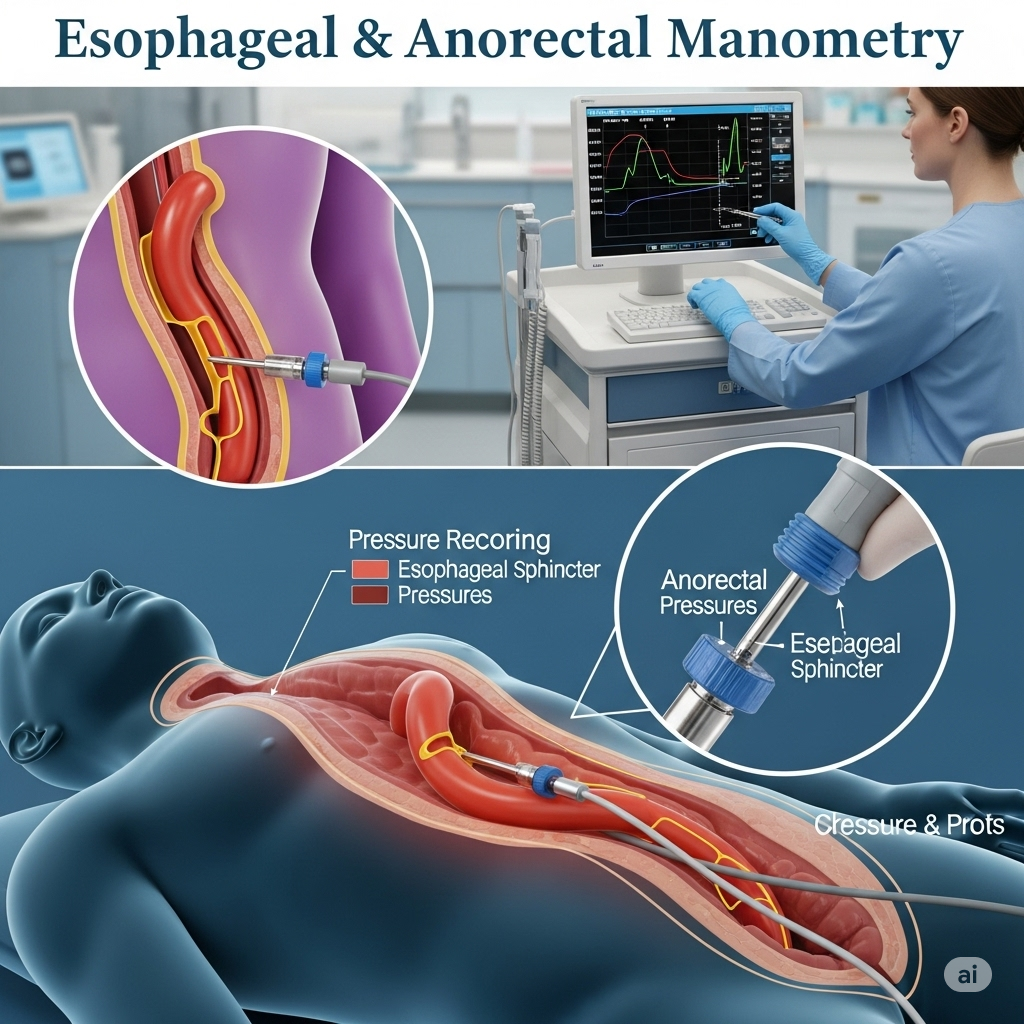
Esophageal & Anorectal Manometry: Precision Diagnostics for Motility Issues
The digestive system relies on coordinated muscle contractions (motility) to move food and waste efficiently. When these muscles don't function properly, it can lead to various symptoms and disorders. **Manometry tests**, including Esophageal Manometry and Anorectal Manometry, are specialized diagnostic tools used by Dr. Neeraj Dhar to accurately assess the pressure and coordination of muscles in specific parts of the gastrointestinal tract.
What is Esophageal Manometry?
Esophageal Manometry measures the strength and coordination of muscle contractions in your esophagus and the function of the lower and upper esophageal sphincters. It is crucial for diagnosing swallowing disorders (dysphagia) and other conditions related to esophageal motility.
Indications for Esophageal Manometry:
- Difficulty Swallowing (Dysphagia): When the feeling of food getting stuck persists.
- Non-Cardiac Chest Pain: To determine if esophageal spasms or other motility issues are causing chest pain.
- Persistent Heartburn/Regurgitation: Especially when symptoms don't respond to medication, to assess esophageal function before anti-reflux surgery.
- Globus Sensation: A persistent feeling of a lump in the throat.
How Esophageal Manometry is Performed:
- A thin, flexible tube (catheter) containing multiple pressure sensors is gently passed through your nostril, down your throat, and into your esophagus.
- You will be asked to swallow small sips of water at specific intervals while the sensors record the pressure changes and muscle contractions.
- The test typically takes about 30-45 minutes.
What is Anorectal Manometry?
Anorectal Manometry evaluates the pressure and coordination of the muscles in your rectum and anal canal, including the internal and external anal sphincters. It is vital for diagnosing the causes of chronic constipation, fecal incontinence, and other defecation disorders.
Indications for Anorectal Manometry:
- Chronic Constipation: To identify if muscle coordination issues (dyssynergic defecation) or nerve problems are contributing to difficulty passing stools.
- Fecal Incontinence: To assess the strength of the anal sphincter muscles and rectal sensation.
- Pre-Operative Assessment: Before certain colorectal surgeries.
- Rectal Hyposensitivity/Hypersensitivity: Abnormal sensation in the rectum.
How Anorectal Manometry is Performed:
- A thin, flexible catheter with a balloon at its tip is gently inserted a few inches into your rectum.
- Pressure sensors in the catheter measure the strength of your anal sphincter muscles at rest and during squeezing.
- You will be asked to perform various maneuvers, such as squeezing, pushing, and coughing, and the balloon may be inflated to assess rectal sensation and reflexes.
- The test usually takes about 20-30 minutes.
Preparation for Manometry Tests:
- Esophageal Manometry: You will need to fast for 6-8 hours prior to the test. Certain medications that affect esophageal motility (e.g., narcotics, calcium channel blockers) may need to be stopped beforehand, as advised by Dr. Dhar.
- Anorectal Manometry: You will typically be asked to administer a rectal enema a few hours before the test to ensure the rectum is empty. Avoid taking laxatives or medications that affect bowel motility on the day of the test, unless instructed otherwise.
Why Choose Dr. Neeraj Dhar for Manometry Tests?
Dr. Neeraj Dhar is a leading gastroenterologist in Faridabad with extensive experience in diagnosing and managing complex gastrointestinal motility disorders. His expertise in interpreting the intricate data from high-resolution manometry tests ensures an accurate diagnosis, which is critical for developing an effective treatment plan. Dr. Dhar and his team provide a comfortable and supportive environment for patients undergoing these specialized tests, ensuring precise results to guide your care.
If you are experiencing persistent swallowing difficulties, non-cardiac chest pain, chronic constipation, or fecal incontinence, consult Dr. Neeraj Dhar for expert evaluation and advanced motility testing.