
ESD (Endoscopic Submucosal Dissection)
- Advanced Endoscopy
- Upper GI Endoscopy
- Lower GI Endoscopy (Colonoscopy)
- ERCP (CBD Stone Removal / Stenting)
- EUS Guided Procedures (FNA/FNB, Drainage)
- Single / Double Balloon Enteroscopy
- Esophageal / Antral Stenting
- Esophageal & Anorectal Manometry
- Foreign Body Removal
- PEG Tube Placement
- POEM (Peroral Endoscopic Myotomy)
- STER (Submucosal Tunneling Endoscopic Resection)
- ESD (Endoscopic Submucosal Dissection)
- EMR (Endoscopic Mucosal Resection)
- Spyglass for Pancreatic Biliary Pathology
- Gastrointestinal Bleeding
- Biliary & Pancreatic Stenting
- Anti Reflux Procedures
ESD: Curative Endoscopic Resection for Early GI Cancers
ESD (Endoscopic Submucosal Dissection): Advanced Resection for Early GI Lesions
**Endoscopic Submucosal Dissection (ESD)** is a highly advanced, minimally invasive endoscopic procedure used for the precise and complete removal of large, flat, or early cancerous/precancerous lesions from the gastrointestinal tract. Unlike conventional polypectomy or Endoscopic Mucosal Resection (EMR) which often remove lesions in fragments, ESD allows for "en bloc" (one-piece) removal, providing a more accurate pathological assessment and a higher chance of curative resection without traditional surgery.
What is ESD?
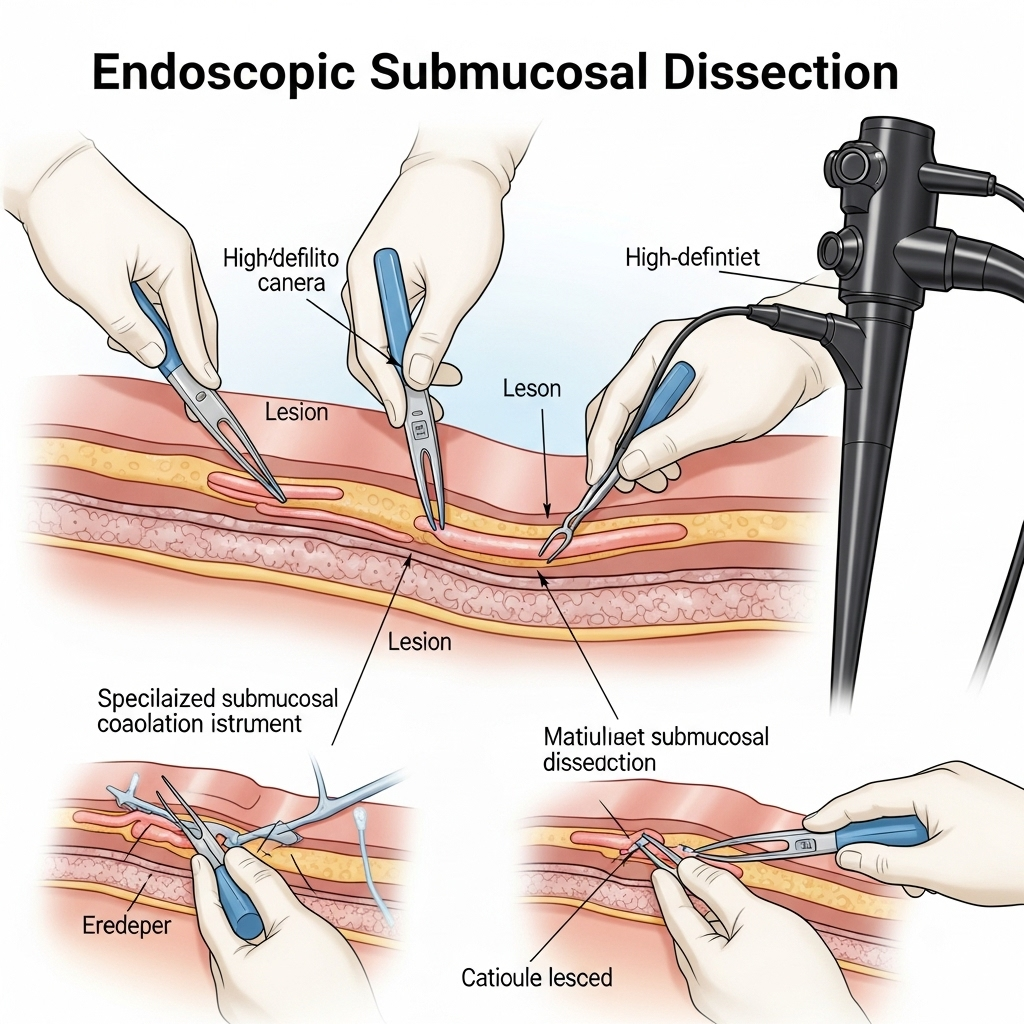
ESD is a sophisticated technique performed using a specialized endoscope and electrocautery knives. It involves creating an incision around the lesion and then carefully dissecting it from the underlying muscle layer, entirely through the endoscope. This allows for the removal of larger and more complex lesions that were previously only removable by surgery.
Indications for ESD:
ESD is primarily used for lesions with a high risk of containing early-stage cancer or those that are too large or morphologically unsuitable for standard EMR. Common indications include:
- Early Gastric Cancer: Superficial adenocarcinoma of the stomach that has not invaded deeply and has no lymph node involvement.
- Large Colorectal Polyps: Especially flat or laterally spreading tumors (LSTs) over 2 cm, which are challenging to remove completely with EMR.
- Barrett's Esophagus with High-Grade Dysplasia or Early Esophageal Cancer: For localized lesions in the esophagus.
- Early Duodenal Neoplasms: For select superficial lesions in the duodenum.
- Recurrent Lesions: After previous incomplete endoscopic removal.
Advantages of ESD:
- **Curative Resection:** Higher rate of complete (en bloc) removal, which is crucial for achieving a cure for early cancers.
- **Accurate Pathology:** Allows for a precise pathological evaluation of the lesion, including margins, which helps in determining further treatment.
- **Minimally Invasive:** Avoids open or laparoscopic surgery, leading to shorter hospital stays, less pain, faster recovery, and no external scars.
- **Organ Preservation:** Preserves the affected organ, maintaining its function.
Preparation for the Procedure:
- You will need to fast for 8-12 hours prior to the procedure.
- For colorectal ESD, a thorough bowel preparation similar to a colonoscopy will be required.
- All medications, especially blood thinners, must be discussed and adjusted by Dr. Dhar well in advance.
- A detailed discussion of the procedure, risks, and benefits will take place.
- General anesthesia or deep sedation will be administered, so arrange for someone to drive you home.
What to Expect During the ESD Procedure:
- ESD is performed under deep sedation or general anesthesia.
- Dr. Dhar uses a high-definition endoscope equipped with a special cap and various types of ESD knives.
- The lesion's boundaries are meticulously marked with a cautery device.
- A liquid solution is injected into the submucosal layer beneath the lesion, lifting it and creating a working space.
- A circular incision is made around the lesion.
- The lesion is then carefully dissected away from the muscular layer underneath, allowing for its removal in a single piece.
- Any bleeding points are precisely coagulated, and large mucosal defects may be closed with endoscopic clips.
- The procedure is technically challenging and can take anywhere from 1 to several hours, depending on the lesion's size and location.
Recovery and Post-Procedure Care:
- Patients typically require a hospital stay for 1-3 days for observation.
- A liquid diet will be prescribed initially, gradually advancing to soft foods.
- Monitoring for potential complications like delayed bleeding, perforation, or stricture formation is crucial.
- Regular follow-up endoscopies are essential to ensure complete healing and monitor for recurrence.
Why Choose Dr. Neeraj Dhar for ESD?
ESD is a highly specialized and technically demanding procedure that requires extensive training and experience. Dr. Neeraj Dhar is one of the few gastroenterologists in Faridabad and the NCR region with the expertise and proficiency to perform ESD. His advanced skills in endoscopic diagnostics (including EUS) and therapeutic procedures make him uniquely qualified to identify suitable lesions and perform complex resections with precision, offering patients a non-surgical curative option for early GI cancers and large precancerous lesions. Dr. Dhar's commitment to patient safety and excellent outcomes positions him as a leader in advanced therapeutic endoscopy.
If you have been diagnosed with a large polyp, high-grade dysplasia, or early GI cancer, consult Dr. Neeraj Dhar to determine if ESD is a suitable and curative treatment option for you.