

Whipple Surgery (Pancreaticoduodenectomy)
- GI & Bariatric Surgery
- Whipple Surgery
- Bariatric Surgery
- Liver Resection
- Gastro Esophageal Surgeries
- Colorectal Surgeries
- Appendectomy
- Hemorrhoidectomy
- Partial Colectomy
- Nissen Fundoplication
- Peptic / Gastric Ulcer Treatment
- Piles Surgery
- Gastrointestinal Surgery
- Surgery for Morbid Obesity
- Hepatopancreaticobiliary Surgery
- Post-Cholecystectomy Bile Duct Injury
- Incisional Hernia
- Minimally Invasive Surgery
- Gallbladder (Biliary) Stone Treatment
Whipple Surgery (Pancreaticoduodenectomy)
Whipple Surgery: A Complex Procedure for Pancreatic and GI Cancers
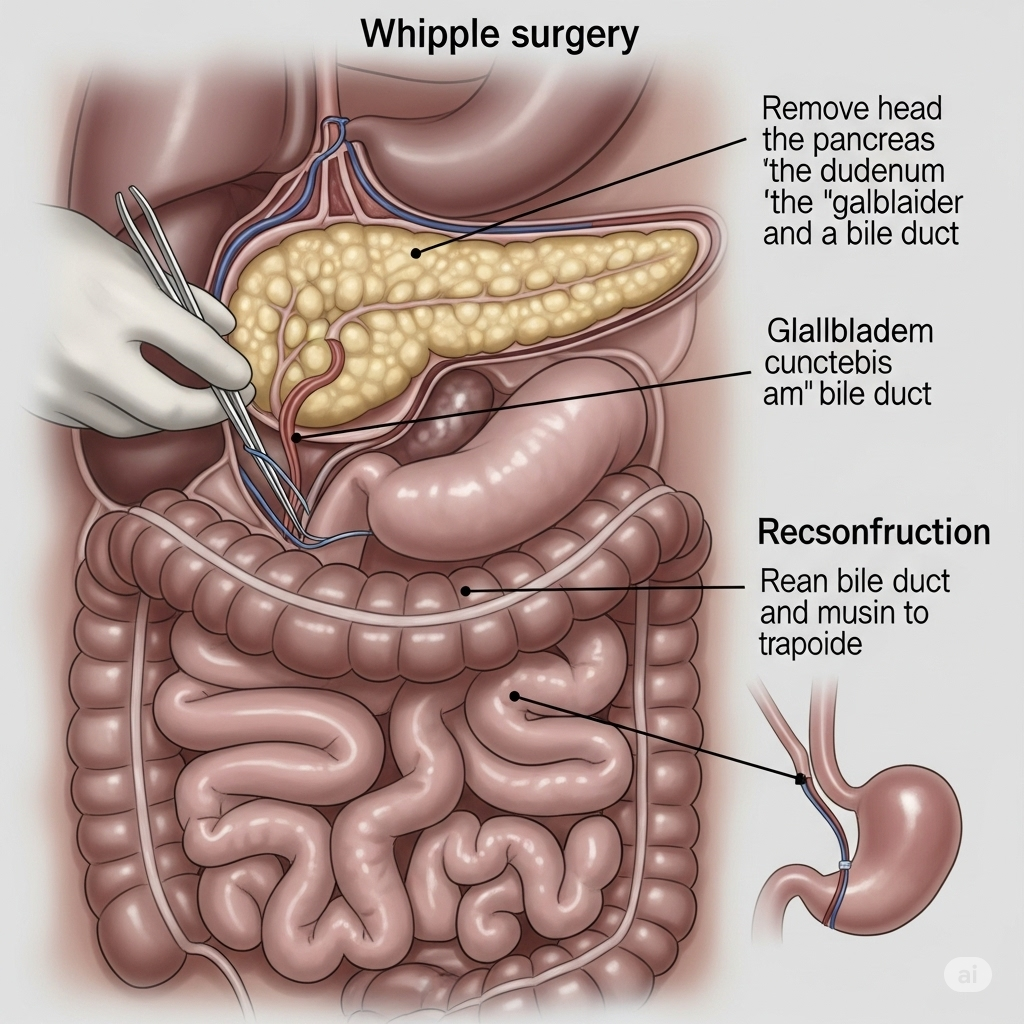
**Whipple Surgery**, formally known as **Pancreaticoduodenectomy**, is one of the most complex and demanding surgical procedures performed on the digestive system. It is primarily undertaken to treat tumors and other conditions affecting the head of the pancreas, the duodenum (first part of the small intestine), the bile duct, and sometimes the surrounding structures. For many patients with pancreatic cancer, Whipple surgery offers the only potential for long-term survival and cure. While Dr. Neeraj Dhar, as a leading Gastroenterologist, does not perform the surgery himself, he plays a crucial role in the initial diagnosis, precise staging (often with EUS-guided biopsy), pre-operative optimization, and post-operative management and surveillance for patients undergoing this major operation.
What is Whipple Surgery?
The Whipple procedure involves the removal of several organs and then reconnecting the remaining digestive tract. Specifically, the surgeon typically removes:
- The **head of the pancreas** (the widest part, nestled in the curve of the duodenum).
- The **duodenum** (the first part of the small intestine).
- The **gallbladder**.
- A portion of the **common bile duct**.
- In some cases, a small portion of the **stomach** (pylorus-preserving Whipple) or a larger part of the stomach (classical Whipple), and nearby **lymph nodes** for cancer staging.
After these parts are removed, the remaining sections of the pancreas, bile duct, and stomach (or esophagus) are carefully reconnected to the small intestine to allow food and digestive juices to flow normally.
Indications for Whipple Surgery:
This surgery is primarily performed for:
- **Pancreatic Cancer:** Especially adenocarcinoma located in the head of the pancreas. This is the most common indication.
- **Distal Bile Duct Cancer:** Cancers originating in the lower part of the bile duct.
- **Ampullary Carcinoma:** Cancer arising from the ampulla of Vater, where the bile duct and pancreatic duct join.
- **Duodenal Cancer:** Cancers in the first part of the small intestine.
- **Certain Pancreatic Neuroendocrine Tumors (PNETs)** or **Gastrointestinal Stromal Tumors (GISTs)**.
- **Some benign (non-cancerous) or pre-malignant cysts and tumors** in the head of the pancreas that have a high risk of becoming cancerous.
- Rarely, for severe, intractable **chronic pancreatitis** not responding to other treatments.
Benefits of Whipple Surgery:
- For resectable cancers, it offers the **best chance for long-term survival and potential cure**.
- Can relieve symptoms such as jaundice (yellowing of the skin), pain, and obstruction caused by the tumor.
- Provides definitive pathological diagnosis and staging.
Preparation for Whipple Surgery:
Given the complexity, preparation is extensive and multidisciplinary, involving a surgical oncologist, gastroenterologist, radiologist, and other specialists. Dr. Neeraj Dhar's role often includes:
- **Accurate Diagnosis and Staging:** Utilizing advanced endoscopic techniques like **Endoscopic Ultrasound (EUS) with Fine Needle Aspiration (FNA)/Biopsy** to precisely diagnose the tumor type, assess its extent, and determine if it has invaded nearby blood vessels (which impacts resectability).
- **Biliary Drainage:** If jaundice is present due to bile duct obstruction, an ERCP with stent placement may be performed by Dr. Dhar to relieve the obstruction before surgery, improving the patient's condition.
- **Nutritional Optimization:** Ensuring the patient is well-nourished before surgery, as pancreatic diseases can lead to malabsorption.
- **Overall Health Assessment:** Evaluating the patient's general health, cardiac, and pulmonary function to ensure they can withstand a major surgery.
What to Expect During and After the Procedure:
- **Duration:** Whipple surgery is a lengthy procedure, typically lasting 5-8 hours.
- **Anesthesia:** Performed under general anesthesia.
- **Surgical Approach:** Can be performed via traditional open surgery (large incision) or, in select cases and centers of excellence, laparoscopically or robotically (minimally invasive).
- **Hospital Stay:** Patients typically stay in the hospital for 7-14 days, often including an initial period in the Intensive Care Unit (ICU).
- **Recovery:** This is a gradual process. Initial recovery involves managing pain, nausea, and beginning oral intake. Patients will experience significant fatigue. Full recovery can take 2-3 months or longer.
- **Dietary Changes:** A slow progression from liquids to soft foods, and then to a regular diet, often with small, frequent meals. Pancreatic enzyme supplements may be necessary long-term to aid digestion.
Potential Risks and Complications:
Whipple surgery carries significant risks, which are minimized at high-volume centers with experienced surgeons and multidisciplinary teams. Complications can include:
- **Pancreatic Leak:** Leakage of pancreatic fluid from the connection site, which can lead to infection or abscess. This is one of the most serious complications.
- **Delayed Gastric Emptying:** The stomach takes longer than usual to empty, causing nausea and vomiting.
- **Bleeding:** During or after surgery.
- **Infection:** At the surgical site or internally.
- **Bile Leak:** Leakage from the bile duct connection.
- **New-Onset Diabetes:** Due to removal of part of the pancreas.
- **Nutritional Malabsorption:** Requiring lifelong enzyme replacement.
- **Fistula formation.**
- **Blood clots.**
Dr. Neeraj Dhar's Role in Whipple Surgery Patients' Care:
While Dr. Neeraj Dhar is a Gastroenterologist and not a surgeon performing the Whipple procedure, his expertise is indispensable for patients undergoing this surgery. He is instrumental in:
- **Precise Pre-operative Diagnosis & Staging:** Using EUS to obtain tissue biopsies and accurately stage pancreatic and related cancers, which is vital for surgical planning and determining resectability.
- **Pre-surgical Biliary Drainage:** Managing obstructive jaundice through ERCP to optimize the patient's condition for surgery.
- **Nutritional Support:** Advising on strategies to improve nutritional status before and after surgery.
- **Post-operative Management:** Addressing gastrointestinal issues that may arise after surgery, such as delayed gastric emptying, malabsorption, or managing new-onset diabetes in coordination with other specialists.
- **Surveillance:** Conducting endoscopic surveillance post-surgery, especially for cancer patients.
- **Multidisciplinary Collaboration:** Collaborating closely with leading surgical oncologists and HPB (Hepato-Pancreato-Biliary) surgeons in Faridabad to ensure comprehensive and seamless care.
If you or a loved one has been diagnosed with a condition that may require Whipple surgery, Dr. Neeraj Dhar provides the crucial diagnostic and supportive care to ensure you are fully prepared and well-managed through this challenging journey, connecting you with the best surgical expertise in Faridabad.