

Liver Resection (Hepatectomy)
- GI & Bariatric Surgery
- Whipple Surgery
- Bariatric Surgery
- Liver Resection
- Gastro Esophageal Surgeries
- Colorectal Surgeries
- Appendectomy
- Hemorrhoidectomy
- Partial Colectomy
- Nissen Fundoplication
- Peptic / Gastric Ulcer Treatment
- Piles Surgery
- Gastrointestinal Surgery
- Surgery for Morbid Obesity
- Hepatopancreaticobiliary Surgery
- Post-Cholecystectomy Bile Duct Injury
- Incisional Hernia
- Minimally Invasive Surgery
- Gallbladder (Biliary) Stone Treatment
Liver Resection (Hepatectomy)
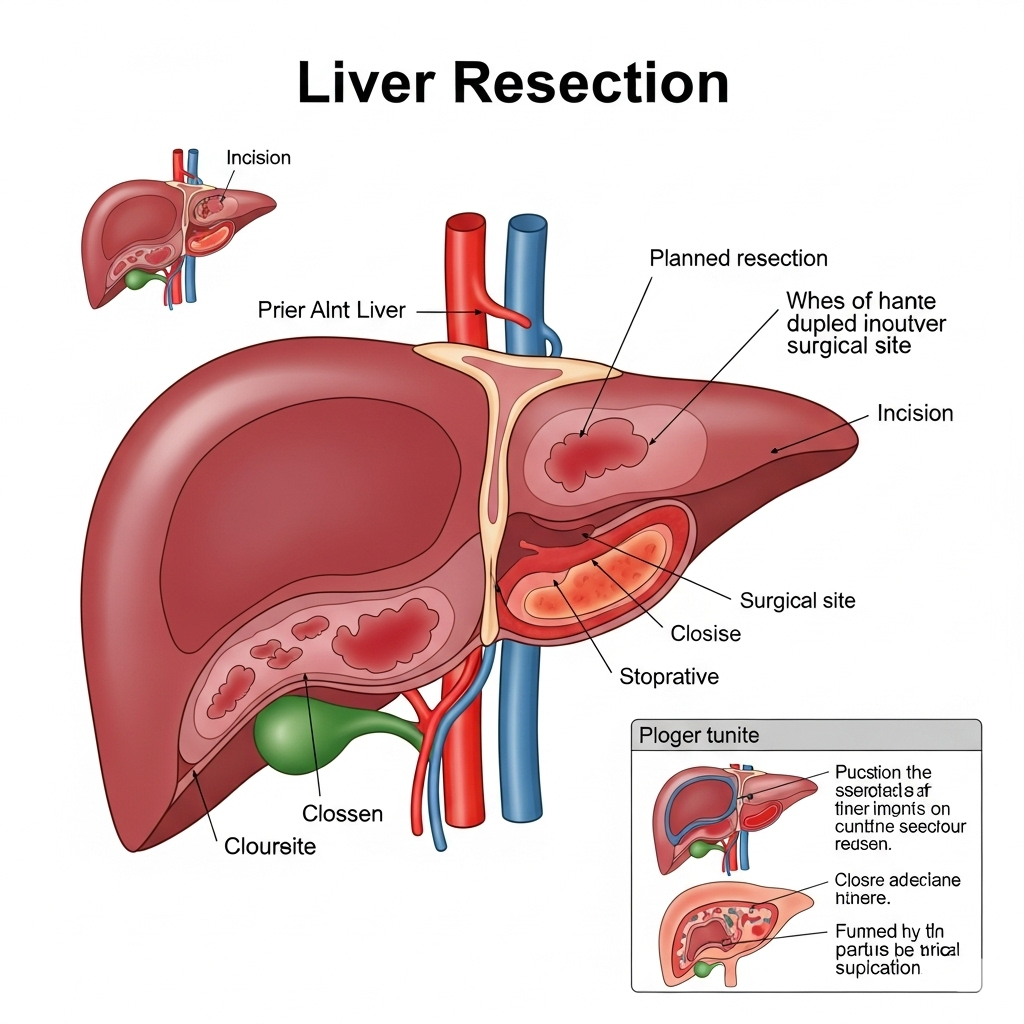
Liver Resection: Surgical Treatment for Liver Tumors and Diseases
**Liver Resection**, also known as **Hepatectomy**, is a major surgical procedure involving the partial removal of the liver. It is a highly effective treatment for various liver conditions, particularly primary liver cancers, metastatic tumors that have spread to the liver (most commonly from colorectal cancer), and certain benign liver masses. The liver has a remarkable ability to regenerate, allowing a significant portion to be removed while the remaining healthy tissue grows back. While Dr. Neeraj Dhar, as a leading Gastroenterologist, does not perform these complex surgeries himself, he plays an indispensable role in the **multidisciplinary management** of patients requiring liver resection, focusing on expert diagnosis, pre-operative optimization, and post-operative gastrointestinal and biliary care in Faridabad.
Understanding Liver Resection and its Purpose:
The goal of liver resection is to remove diseased or cancerous parts of the liver while preserving enough healthy liver tissue to ensure normal function. This surgery is often the best chance for cure or long-term control for select liver cancers.
Indications for Liver Resection:
Liver resection is typically considered for:
- **Primary Liver Cancers:**
- **Hepatocellular Carcinoma (HCC):** The most common type of liver cancer, often arising in patients with chronic liver disease (e.g., cirrhosis).
- **Cholangiocarcinoma:** Cancer of the bile ducts within the liver (intrahepatic).
- **Metastatic Liver Tumors:** Cancers that have spread to the liver from other organs, primarily **colorectal liver metastases**. Liver resection can significantly improve survival in these cases.
- **Certain Benign Liver Tumors:** Such as large or symptomatic hepatic adenomas, focal nodular hyperplasia (FNH), or hemangiomas.
- **Large or Symptomatic Liver Cysts.**
- **Intrahepatic Gallstones** leading to recurrent infections.
The decision for resection depends on the tumor's size, location, number, the patient's overall liver function, and general health.
Types of Liver Resection:
The extent of liver removal can vary from:
- **Wedge Resection/Non-anatomic Resection:** Removal of a small, localized portion of the liver.
- **Segmentectomy/Sectionectomy:** Removal of one or more functional segments of the liver.
- **Hepatectomy:** Removal of a larger lobe or multiple segments of the liver (e.g., Right Hepatectomy, Left Hepatectomy).
Liver resections can be performed via open surgery (traditional large incision) or, increasingly, using minimally invasive techniques like **laparoscopic or robotic surgery**, which may offer faster recovery and less pain for suitable candidates.
Dr. Neeraj Dhar's Crucial Role in Liver Resection Patient Care:
As a leading Gastroenterologist and Liver Specialist, Dr. Neeraj Dhar's expertise is invaluable at every stage of the liver resection journey, even though he is not the performing surgeon. His contributions include:
- **Precise Diagnosis and Staging:**
- Performing **Endoscopic Ultrasound (EUS)** for accurate staging of liver tumors, especially those near the bile ducts, and obtaining biopsies if needed.
- Conducting **ERCP (Endoscopic Retrograde Cholangiopancreatography)** for diagnostic purposes or to relieve biliary obstruction (e.g., stent placement for cholangiocarcinoma) before surgery, improving patient condition.
- **Assessment of Liver Function:** Thoroughly evaluating the patient's underlying liver health, especially if they have chronic liver disease (cirrhosis), which is critical for determining surgical feasibility and predicting post-operative recovery.
- **Pre-operative Optimization:** Working with the surgical team to optimize the patient's nutritional status and overall health before surgery.
- **Management of Underlying Liver Disease:** Providing ongoing management for conditions like hepatitis, cirrhosis, or fatty liver disease, which can impact surgical outcomes and long-term liver health.
- **Post-operative Complication Management:** Using his advanced endoscopic skills to manage potential post-surgical complications such as:
- **Bile Leaks:** Endoscopic stent placement via ERCP can often resolve bile leaks that may occur after surgery.
- **Biliary Strictures:** Dilation and stenting of narrowed bile ducts.
- **Fluid Collections:** Drainage of collections if amenable to endoscopic guidance.
- Managing general gastrointestinal issues that can arise after major abdominal surgery.
- **Long-Term Follow-up and Surveillance:** For cancer patients, Dr. Dhar provides crucial long-term surveillance through imaging and endoscopic checks to monitor for recurrence and manage liver health.
- **Multidisciplinary Team Approach:** Collaborating seamlessly with Hepato-Pancreato-Biliary (HPB) surgeons, oncologists, radiologists, and pathologists to ensure integrated, patient-centered care.
Liver resection is a life-saving procedure that requires a highly coordinated and expert team. Dr. Neeraj Dhar's role as a gastroenterologist ensures that patients in Faridabad receive comprehensive diagnostic, pre-operative, and post-operative care, optimizing their journey towards recovery and improved health. If you are considering or have been recommended for liver resection, consult Dr. Neeraj Dhar for expert guidance and supportive care.